
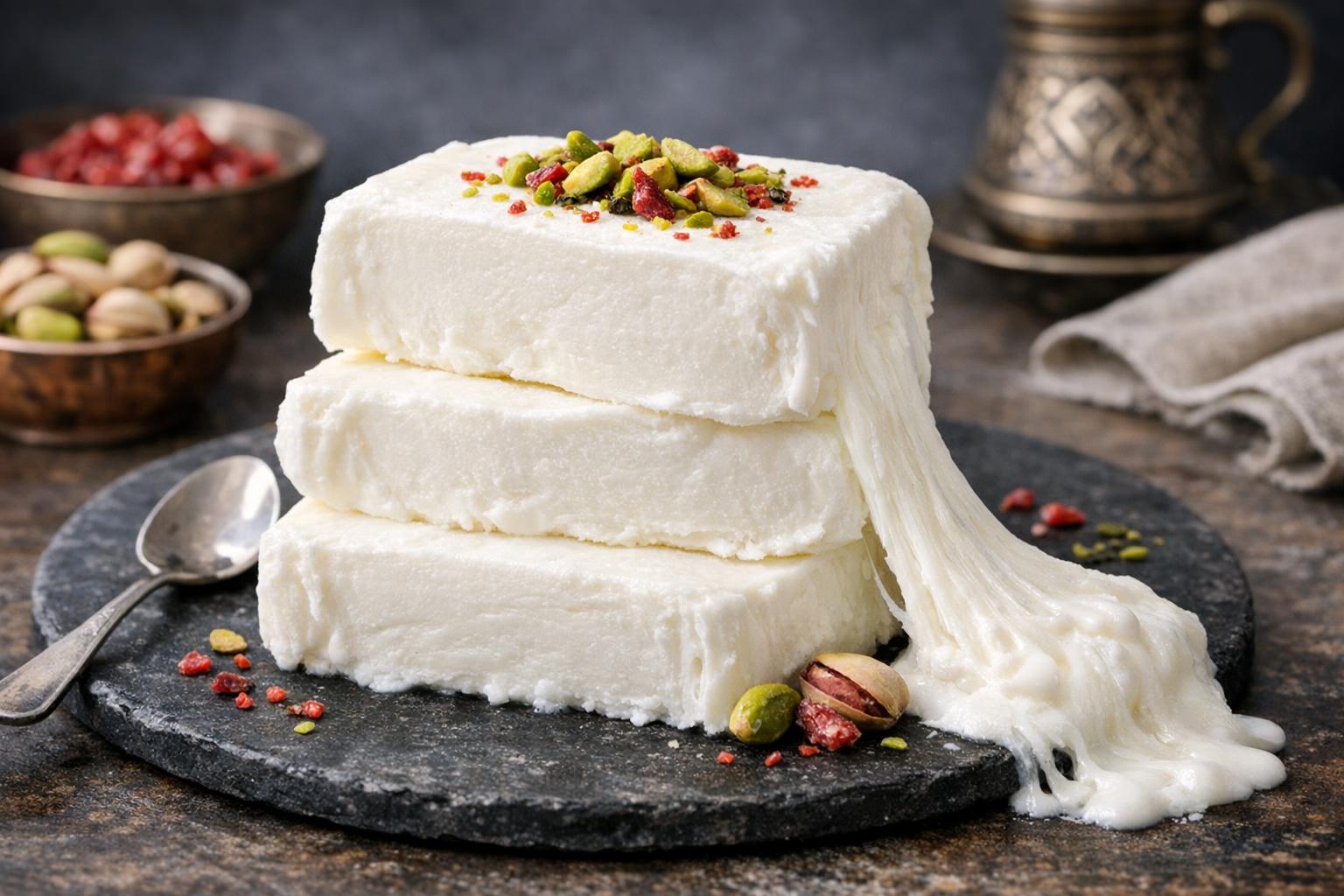
Traditional Turkish Maraş Ice Cream with Salep and Mastic
Maraş Dondurması
This legendary Turkish ice cream delivers an incredibly chewy, stretchy texture that's unlike any other frozen dessert in the world. The pristine white ice cream has a rich, creamy flavor with subtle floral notes from mastic and earthy sweetness from salep. You should make this because it's an extraordinary culinary experience that will amaze anyone who tries it.
Ingredients
Instructions
-
Prepare salep mixture
Mix salep powder with 100ml cold milk in a small bowl, whisking vigorously until completely smooth with no lumps. Let stand at room temperature for 10 minutes to fully hydrate. The mixture should become slightly thicker and gel-like. Do not add hot liquid directly to salep powder as it will form lumps that won't dissolve.
-
Heat milk and cream
Pour remaining milk and heavy cream into a heavy-bottomed saucepan. Heat over medium-low heat for 8-10 minutes, stirring occasionally, until the mixture reaches 75°C and begins to steam gently. Do not let it boil or the proteins will curdle and ruin the smooth texture.
-
Add sugar and dissolve
Add sugar to the heated milk mixture and stir constantly over medium-low heat for 3-4 minutes until completely dissolved. The mixture should coat the back of a spoon lightly and taste sweet but not overpowering. Do not increase heat as this can cause the milk to scorch on the bottom.
-
Incorporate salep mixture
Slowly whisk the prepared salep mixture into the hot milk, stirring continuously over low heat for 15-20 minutes. The mixture will gradually thicken to a custard-like consistency that coats the spoon heavily. Do not stop stirring or lumps will form and the salep won't distribute evenly.
-
Add mastic and vanilla
Remove from heat and immediately whisk in mastic powder and vanilla extract. Stir vigorously for 2-3 minutes until the mastic is completely dissolved and the mixture smells aromatic with pine-like notes. Do not add mastic while still on heat as it can become bitter and lose its delicate flavor.
-
Cool the mixture
Cover the surface directly with plastic wrap to prevent a skin forming. Refrigerate for 4-6 hours until completely cold, around 4°C. The mixture should be thick enough to coat a spoon heavily when chilled. Do not rush this step as warm mixture won't churn properly in the ice cream maker.
-
Churn in ice cream maker
Pour the cold mixture into your ice cream maker and churn according to manufacturer's instructions, typically 25-35 minutes. The ice cream is ready when it pulls away from the sides and has a very thick, almost chewy consistency. Do not over-churn as this can make the texture grainy rather than smooth and elastic.
-
Final freezing
Transfer to an airtight container and freeze for at least 4 hours until firm enough to scoop with effort. The finished ice cream should be dense and stretchy, requiring some force to scoop. Do not expect it to be as soft as regular ice cream - the characteristic chewiness is what makes it authentic.
Tips
Cooking Tips
Grind whole mastic tears yourself using a mortar and pestle with a pinch of sugar - pre-ground mastic often lacks the intense aromatic oils that give authentic flavor and the sugar helps prevent the resin from sticking to the pestle.
Alternatives
If salep powder is unavailable, substitute with 15g cornstarch mixed with 2 tsp ground vanilla, though the texture won't be as authentically chewy and stretchy as traditional Maraş ice cream.
Serving & Storage
Serve in small portions using a sturdy spoon or knife to cut through the dense texture, traditionally accompanied by chopped pistachios or a drizzle of rose syrup, and store covered for up to 1 month in the freezer where it maintains its unique chewy consistency.

Leave a Comment