
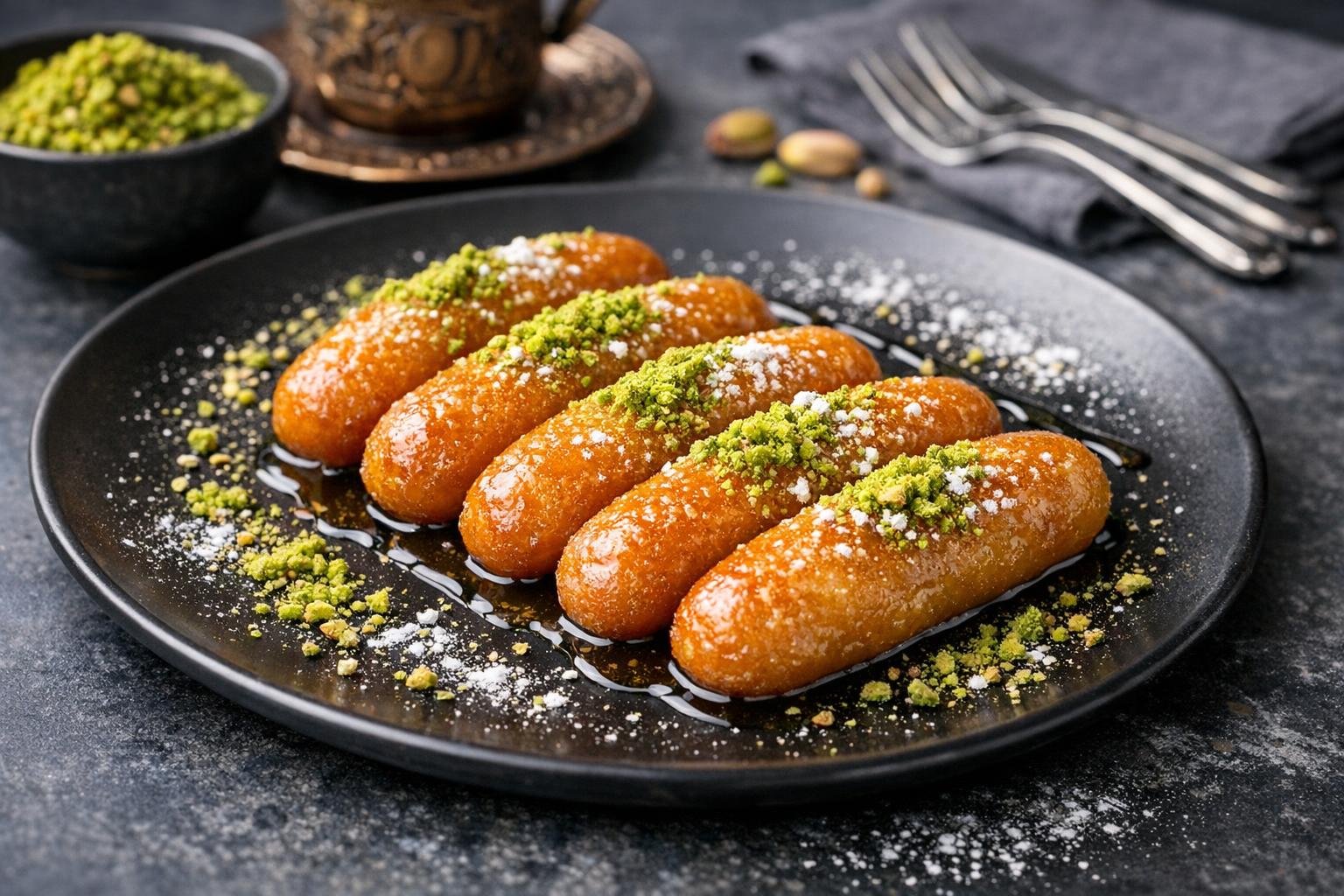
Vezir Parmağı - Turkish Syrup-Soaked Finger Pastries
Vezir Parmağı
These delicate finger-shaped pastries taste like sweet, syrup-soaked clouds with a hint of lemon and rose water. Golden and glistening with their glossy syrup coating, they practically melt in your mouth. Perfect for impressing guests or treating yourself to an authentic Ottoman-era dessert.
Ingredients
Instructions
-
Prepare the syrup
Combine sugar and water in a medium saucepan. Bring to a boil over high heat for 2-3 minutes, then reduce to medium heat. Add lemon juice and simmer for 8-10 minutes until the syrup coats the back of a spoon and reaches soft ball consistency. Remove from heat, stir in rose water and vanilla, then let cool completely. Do not stir while boiling or the syrup will crystallize.
-
Melt butter
Melt butter in a small saucepan over low heat for 3-4 minutes until completely liquid and slightly golden. Remove from heat and let cool for 5 minutes until warm but not hot. Do not let the butter brown or smoke as it will create a bitter taste.
-
Prepare phyllo sheets
Carefully unroll phyllo pastry and cover with a damp kitchen towel. Take one sheet and place on a clean work surface. Brush entire surface evenly with melted butter using a pastry brush. The phyllo should glisten but not be soaked. Do not let phyllo dry out or it will crack when rolling.
-
Cut phyllo strips
Using a sharp knife, cut the buttered phyllo sheet into 6 equal strips lengthwise, each about 5cm wide. Work quickly over medium speed for 2-3 minutes to prevent drying. Each strip should be smooth and even. Do not press too hard when cutting or the layers will stick together.
-
Form finger shapes
Take each strip and gently roll it around a thin wooden skewer or pencil, creating a loose spiral. Roll over low pressure for 1-2 minutes, leaving small gaps between layers. The pastry should hold its shape but not be tight. Do not compress the rolls or they won't absorb syrup properly.
-
Remove skewers
Carefully slide the wooden skewers out of each rolled pastry, leaving hollow finger-shaped tubes. Handle gently for 30 seconds per piece, supporting the pastry as you remove the skewer. The tubes should maintain their shape and feel delicate. Do not squeeze or the pastry will lose its airy texture.
-
Bake the pastries
Preheat oven to 180°C. Place pastry fingers on a parchment-lined baking sheet, spacing them 3cm apart. Bake for 12-15 minutes until golden brown and crispy. They should sound hollow when tapped and feel light. Do not overbake or they will become too hard to absorb syrup.
-
Soak with syrup
While pastries are still warm from the oven, immediately pour the cooled syrup over them using a spoon. Let them soak for 15-20 minutes, turning once halfway through until they absorb most of the syrup and become glossy. They should feel tender but not soggy. Do not use hot syrup on hot pastries or they will become mushy.
-
Garnish and serve
Sprinkle chopped pistachios over the syrup-soaked pastries and let rest at room temperature for 10-15 minutes. The pastries should glisten with syrup and feel slightly firm to touch. Arrange on serving plates immediately. Do not refrigerate as this will make the pastry tough.
Tips
Cooking Tips
Keep one phyllo sheet covered with a damp towel while working with others, and brush each layer thoroughly with butter to ensure crispy, flaky layers that won't stick together during rolling.
Alternatives
If phyllo pastry isn't available, you can use thin spring roll wrappers, though the texture will be slightly different - less flaky but still delicious when properly buttered and baked.
Serving & Storage
Serve at room temperature within 4 hours of making for the best texture contrast. Store leftovers covered at room temperature for up to 2 days, though they're best enjoyed fresh. Pair with strong Turkish coffee or mint tea.
Leave a Comment